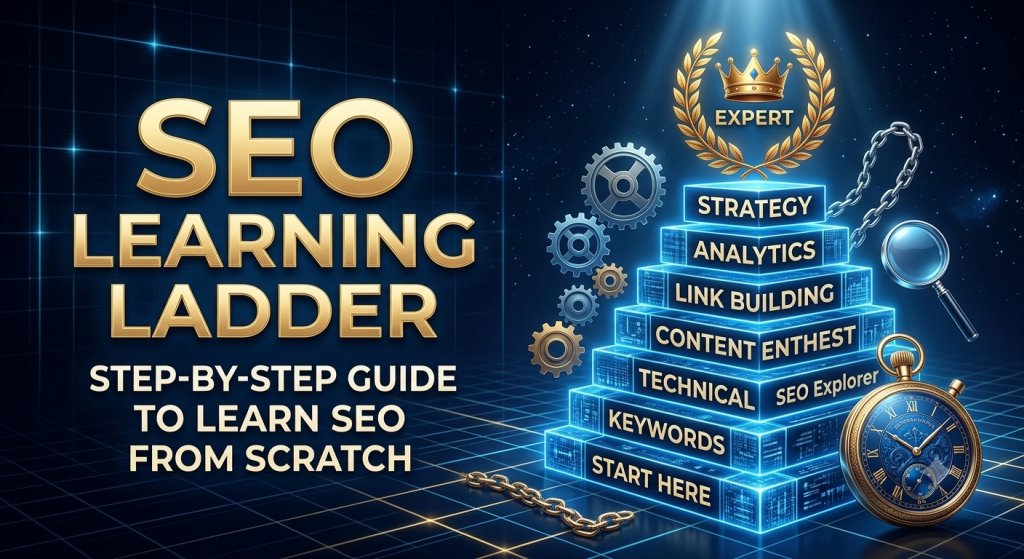
Search Engine Optimization (SEO) is one of the most powerful digital skills in today’s online world. Whether you want to grow a business, build a personal brand, or earn money online, SEO can help you achieve your goals. However, beginners often feel overwhelmed because there is no clear SEO Learning Ladder to follow.
Many learners jump from one topic to another—watching random tutorials, reading scattered blogs, and trying different tools—without understanding the proper sequence. This leads to confusion and slow progress.
That’s why this SEO Learning Ladder is designed—to give you a step-by-step, structured roadmap so you can learn SEO in the correct order. If you follow this guide properly, you won’t need any separate curriculum—just consistent practice and occasional AI help.
The SEO Learning Ladder
Step 1: Understand How Search Engines Work
Before stepping up the SEO Learning Ladder, you must understand how search engines like Google actually work
Search engines follow three main processes:
a. Crawling
Search engines use bots (also called spiders) to discover new and updated pages on the internet. These bots follow links from one page to another.
b. Indexing
In an SEO learning ladder, indexing fits in as one of the core foundation steps usually after crawling / technical basics and alongside on page optimization.
c. Ranking
When a user searches for something, Google ranks pages based on relevance, quality, and authority.
Your Goal in this step:
Understand how websites appear in search results
Learn basic SEO terms (crawl, index, rank)
Step 2: Learn Basic SEO Concepts
Now that you understand how search engines work, the next step is learning the core types of SEO.
On-Page SEO
Optimizing elements on your website:
Content
Headings
Keywords
Internal links
Off-Page SEO
Activities outside your website:
Backlinks
Social sharing
Brand mentions
Technical SEO
Improving website structure:
Speed
Mobile-friendliness
Crawlability
Your Goal:
Build a strong foundation before moving into advanced topics.
Step 3: Keyword Research (The Heart of SEO)
Keyword research is the most important step of the SEO Learning Ladder. Without it, you are just guessing.
Use tools like:
Google Keyword Planner
Learn these concepts:
Search Intent
Why is the user searching?
Informational (learn something)
- Navigational (find a website)
- Transactional (buy something)
Keyword Types
Short keywords (high competition)
Long-tail keywords (low competition, easier to rank)
Keyword Difficulty
Choose keywords that are easy to rank (especially as a beginner).
Your Goal:
Find keywords that your audience is actually searching for.
Step 4: On-Page SEO Optimization
Once you have keywords, you need to optimize your pages properly.
Important elements:
Title Tag
Include your main keyword
Make it attractive
Meta description
Short summary of your page
Encourages users to click
Headings (H1, H2, H3)
Organize your content
Use keywords naturally
URL Structure
Keep it short and clean
Example:
yourwebsite.com/seo-learning-ladder
Internal Linking
Link your pages together
Helps users and search engines
Your Goal
Make your content easy to read and easy to understand for search engines.
Step 5: Technical SEO Basics
Technical SEO ensures that search engines can easily crawl and index your website.
Key areas:
Sitemap
A file that lists all your pages
(Create using Rank Math)
Robots.txt
Controls which pages search engines can access
Page Speed
Faster websites rank better and improve user experience
Mobile Friendliness
Your website must work perfectly on mobile devices
Your Goal:
Make your website technically strong and accessible.
Step 6: Off-Page SEO (Backlinks)
Backlinks are links from other websites to your site. They act like “votes of trust.”
Ways to build backlinks:
Guest posting
Social media sharing
Directory submissions
Networking with other bloggers
Quality matters more than quantity:
One strong backlink is better than many weak ones
Your Goal:
Build authority and trust for your website.
Step 7: Content Creation Strategy
Content is the backbone of SEO.
Types of content:
Blog posts
Guides
Tutorials
Case studies
Focus on:
Quality
Write useful and detailed content
Consistency
Post regularly (at least once a week)
User Intent
Answer the user’s question completely
Your Goal:
Create content that helps people and solves problems.
Step 8: Practice on a Real Website
Theory alone is not enough.
What to do:
Create your own website
Apply SEO techniques
Write blog posts
Optimize pages
Your Goal:
Learn by doing — this is where real growth happens.
Step 9: Advanced SEO (After Basics)
Once you master the basics, move to advanced topics:
Local SEO
Rank for location-based searches
Example: “SEO expert in Nepal”
Content Clusters
Create pillar pages and related articles
AI in SEO
Use AI tools for:
Content ideas
Optimization
Research
Technical Audits
Analyze and fix website issues
Your Goal:
Become a professional SEO expert.
Common Mistakes to Avoid
Skipping basics
Targeting high-competition keywords
Ignoring content quality
Not being consistent
Expecting fast results
How Long Does It Take to Learn SEO?
month → Basic understanding
3 months → Practical skills
6 months → Intermediate level
1 year → Advanced level
SEO is a long-term skill, not a shortcut.
Final Tips for Success
Practice daily
Focus on one step at a time
Keep learning and experimenting
Use AI tools for guidance
Be patient and consistent
Conclusion
The SEO Learning Ladder gives you a clear and structured path to mastering SEO step by step. Instead of feeling lost, you now have a roadmap that guides you from beginner to expert level.