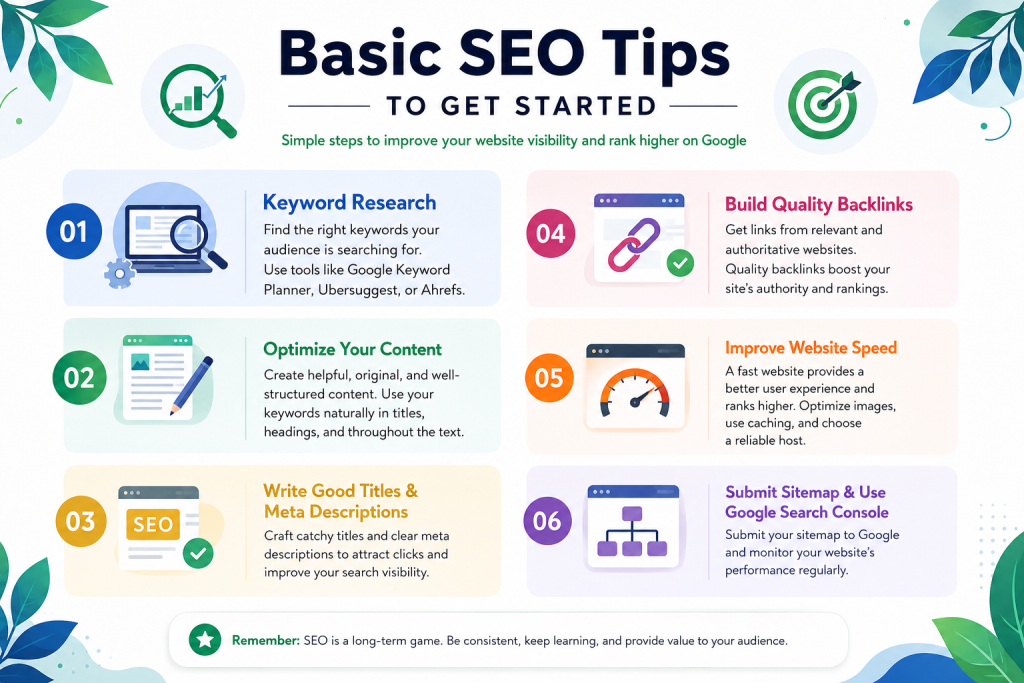
Basic SEO tips for beginners is very essential In the digital landscape of 2026. The old mantra “Build it and they will come” is officially dead. With millions of new pages published every day, the only way to get your voice heard above the noise is through Search Engine Optimization (SEO).
If you are new to the world of digital marketing, SEO can feel like trying to learn a new language while the rules are being rewritten in real-time. But here is the good news: at its core, SEO is simply about being the best answer to someone’s question.
This guide will break down the fundamental pillars of SEO into actionable steps, helping you build a foundation that search engines love and users appreciate.
1. Understanding the SEO Landscape in 2026
Basic SEO tips for beginners start with understanding the “what” before the “how.” In 2026, SEO is no longer just about ranking on page one of Google. It is about appearing in AI Overviews, voice search results, and providing a seamless user experience (UX).
The “Three Pillars” of SEO remain the same, but the way we approach them has evolved:
On-Page SEO: What you say and how you structure it on your site.
Technical SEO: How well search engines can read and access your site.
Off-Page SEO: How much the rest of the internet trusts your site.
2. Keyword Research: Thinking Like Your Audience
Keyword research is the process of finding the actual terms people type into search engines. In 2026, we have moved away from “keyword stuffing” toward Search Intent.
Types of Search Intent
Informational: “How to bake sourdough bread.”
Navigational: “Instagram login.”
Transactional: “Buy organic sourdough starter.”
Commercial Investigation: “Best sourdough bread kits 2026.”
How to Find Keywords
Google Autocomplete: Start typing your topic and see what Google suggests.
People Also Ask (PAA): These are goldmines for blog subheadings.
AI Tools: Use tools like Chat GPT or Perplexity to ask, “What are the common pain points for [Your Topic]?”
Free Tools: Google Keyword Planner and Ubersuggest are excellent starting points for begi
3. On-Page SEO: Optimizing Your Content
Once you have your keywords, you need to place them where they matter most. However, the rule of 2026 is write for humans first, algorithms second.
The Essential On-Page Checklist
Title Tag: Keep it under 60 characters. Place your primary keyword near the beginning.
H1 Header: Every page needs exactly one H1 tag. It should be the “headline” of your article.
Subheadings (H2, H3): Use these to break up your text. Search engines use them to understand the hierarchy of your information.
Meta Description: This is your “sales pitch” in the search results. Keep it under 155 characters and include a call-to-action (CTA).
Image Alt Text: Search engines can’t “see” images. Alt text describes the image for the algorithm and for visually impaired user.
4. Technical SEO: Building a Solid Foundation
You could have the best content in the world, but if your site takes 10 seconds to load, no one will ever see it. Technical SEO ensures that search engine “crawlers” can easily navigate your site.
Core Web Vitals
In 2026, Google heavily weighs Core Web Vitals, which measure your site’s health
LCP (Largest Contentful Paint): How fast the main content loads.
INP (Interaction to Next Paint): How responsive the site feels when a user clicks something.
CLS (Cumulative Layout Shift): Does the content “jump around” while loading.
Quick Technical Wins
Install an SSL Certificate: Your URL should start with
https://. Safety is a ranking factor.Mobile-First Design: Over 60% of searches happen on mobile. If your site looks bad on a phone, you will not rank.
Fix Broken Links: Use a tool like Screaming Frog (free version) to find 404 errors that frustrate users.
5. Content Strategy: Quality Over Quantity
The March 2026 Core Update proved that Google is cracking down on “thin” AI-generated content. To rank today, you need E-E-A-T:
Experience: Personal stories or “I tried this” insights.
Expertise: Demonstrating deep knowledge.
Authoritativeness: Being a go-to source in your niche.
ustworthiness: Citations, transparent bios, and factual accuracy.
The "Skyscraper" Technique
Find the top-ranking article for your keyword. Read it. Now, write something 10x better. Add a video, an infographic, or a more recent case study. If your content is the most helpful, it will eventually climb the ranks.
6. Internal and External Linking
Basic SEO tips for beginners highlight that links are the “highways” of the internet.
Internal Links: Link from your new blog post to older, related posts on your site. This keeps users on your site longer and helps Google find new pages.
External (Outbound) Links: Linking to high-authority sites (like Wikipedia or major news outlets) shows Google that you have done your research.
Backlinks (Inbound): This is the holy grail of SEO. When other sites link to you, it’s a “vote of confidence.” As a beginner, focus on guest posting or creating “linkable assets” like original data or unique infographics.
7. Tracking Your Success
Basic SEO tips for beginners emphasize that SEO is not a “set it and forget it” task—you need to know what’s working.
Google Search Console (GSC): This free tool tells you which keywords are bringing people to your site and flags any indexing errors.
Google Analytics 4 (GA4): This helps you understand user behavior. Are they staying for 5 minutes or leaving after 5 seconds?
Conclusion
Basic SEO tips for beginners remind us that SEO is a marathon, not a sprint. You likely won’t see results tomorrow, or even next week. But by consistently providing value, optimizing your technical foundation, and staying tuned to your audience’s needs, you will build a digital asset that grows in value over time. Stop chasing the algorithm and start chasing the user—when you make the user happy, Google usually follows.